By Vishal Katariya and Akhilesh Jhawar, Ankur Capital, 12/11/2026, 7 min read

By Vishal Katariya and Akhilesh Jhawar, Ankur Capital, 12/11/2026, 7 min read
Most Indian factories have plenty of machines. They don’t have, however, a clear picture of what those machines are doing, when and why they fail, and enough confidence to act on that information. This article is about the companies that will close that gap. We see a new kind of industrial AI company emerging in India, one that pulls together the digital intelligence a factory needs, raises the level of automation, and moves the plant a good way towards full autonomy.
The stack this company builds consists of multiple layers. Edge devices process sensor data at each machine. Machines then sync across lines and plants. A decision layer on top flags problems as they happen and suggests what to do next, across output quality inspection, machine predictive maintenance and cross-factory communication. Together, this is what we call the Industry OS. It gives operators a full view of the floor and gives owners better information to decide with.
Our Manufacturing Report 2026 argued that maximizing Overall Equipment Effectiveness (OEE) across factories globally can unlock $4-6 trillion for manufacturing value-add. OEE is the share of planned time a machine spends making good parts at full speed. Most factories run at 55 to 65% against a benchmark of 85% [1]. Unplanned downtime alone costs the world's 500 largest companies about $1.4 trillion a year, or 11% of their revenues [2]. Data-mature global manufacturers report ~20% higher production output and 34% better plant capacity utilisation from digital initiatives [8].
We believe that an AI-powered Industry OS is key to maximizing OEE on the factory floor, and Indian solutions can enable this for the global market. India is well placed to build these solutions. Its factories span every stage from manual lines to highly automated ones, which makes them a proving ground for the early stages of autonomy, and the country has about a million embedded engineers, who will play a key role in building this stack out.
Mid-market factories in Southeast Asia, the Middle East, Europe and the US run the same PLCs and machine makes as Indian ones, so a product built here needs little rework to be deployed there. Downtime costs more in those markets and customers pay more for the same outcome. We expect Industry OS startups to sell outside India early, and to earn a large part of their revenue there over time.
While an earlier cohort of industrial IoT companies both in India and worldwide attempted this, they were not able to reach widespread deployment across industries or the scale their early promise suggested. Their customers were stuck too: in a 2018 McKinsey survey, 84% of companies running IoT pilots had been stuck in pilot mode for more than a year, and 28% for more than two years [3]. We think the earlier cohort stalled because each deployment stayed a custom project, and focused on creating a stream of data. The data generated was not outcome focused, nor was the data and learnings compounded across plants. Each factory went through a process of learning. What is different now is that AI lets a platform act on the data instead of merely reporting on it and each installation helps in accelerating the learning. These learnings and technology advancements are what make us bullish for the current cohort of Industry OS startups building winning platforms, and doing that out of India.
For now, this is not a robotics-in-manufacturing story; rather, it’s the stepping stone towards enabling more robotics and Physical AI in manufacturing. India installed 10,487 industrial robots in 2025, against China's 354,200. Outside automotive, there is little pull for them. Fewer than 7,000 humanoids were sold worldwide in the same year [4]. We believe India's procurement appetite is not yet ready for fancy robotics, and even demand for functional robots is limited. With a significant under utilization of existing capex, it makes business sense for a shopfloor to first invest in increasing utilization of existing assets, before investing in new automation.
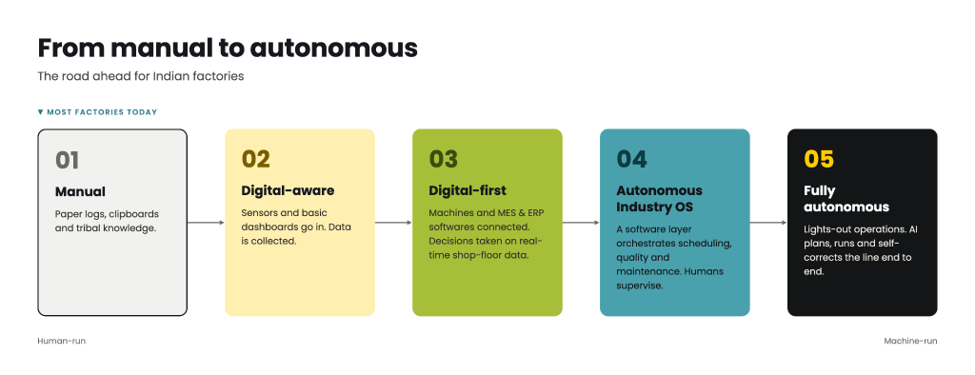
Caption: Most Indian factories still sit at stage one or two, where sensors and basic dashboards are in place but the data is siloed and rarely acted on. The companies we want to back move a plant through stage three, where machines are connected and decisions use live shop-floor data, to stage four, where an Industry OS runs scheduling, quality and maintenance while people supervise. Stage five, a fully autonomous line, is the long-term goal.
There are two major reasons for mid market manufacturers trailing in Physical AI investments. Traditionally any such implementation has been highly disruptive. Projects are typically custom projects and take months/years of consulting work followed by development and implementation. With custom work each time, the credibility of getting reliable outcomes the first time also had low probability. For a manufacturer, unreliable outcomes and disruption in activities during implementation are big risks. The second reason for the low adoption is the cost associated with the custom led development.
Thus, an Industry OS player needs to ensure smooth onboarding, immediate data capture, and no downtime via its intervention. A plant operator wants to avoid downtime as much as possible and seeks to avoid excess cost and delay associated with a custom installation. Thus an Industry OS startup must come to them with enough capability and credibility to earn their trust. This starts with accurate AI/ML models running on their machine makes, accurate data capture and sensors that can be installed instantaneously without interrupting the factory floor operations. Sensors that can be fitted directly and quickly onto machines are now available, and current AI capability ensures that data capture can be translated to basic dashboarding and intelligence immediately. Indian startups we have spoken to can install sensors and get dashboards running in 8 hours without any downtime.
While data is collected by factory operators, it is rarely tied to a business outcome such as yield, delivery or margin. Most of it is kept for auditors. This is not only an Indian problem: in a 2026 survey of 1,560 global manufacturers, respondents said only 43% of the data they collect is used effectively [7]‡. It was found that only 28% of manufacturers used equipment and process data to drive continuous improvement [8]‡. If large global firms struggle with this, the mid-market has further to go. Capturing this data and making it actionable is the next layer of an Industrial OS player’s proposition, particularly to a mid-market manufacturer.
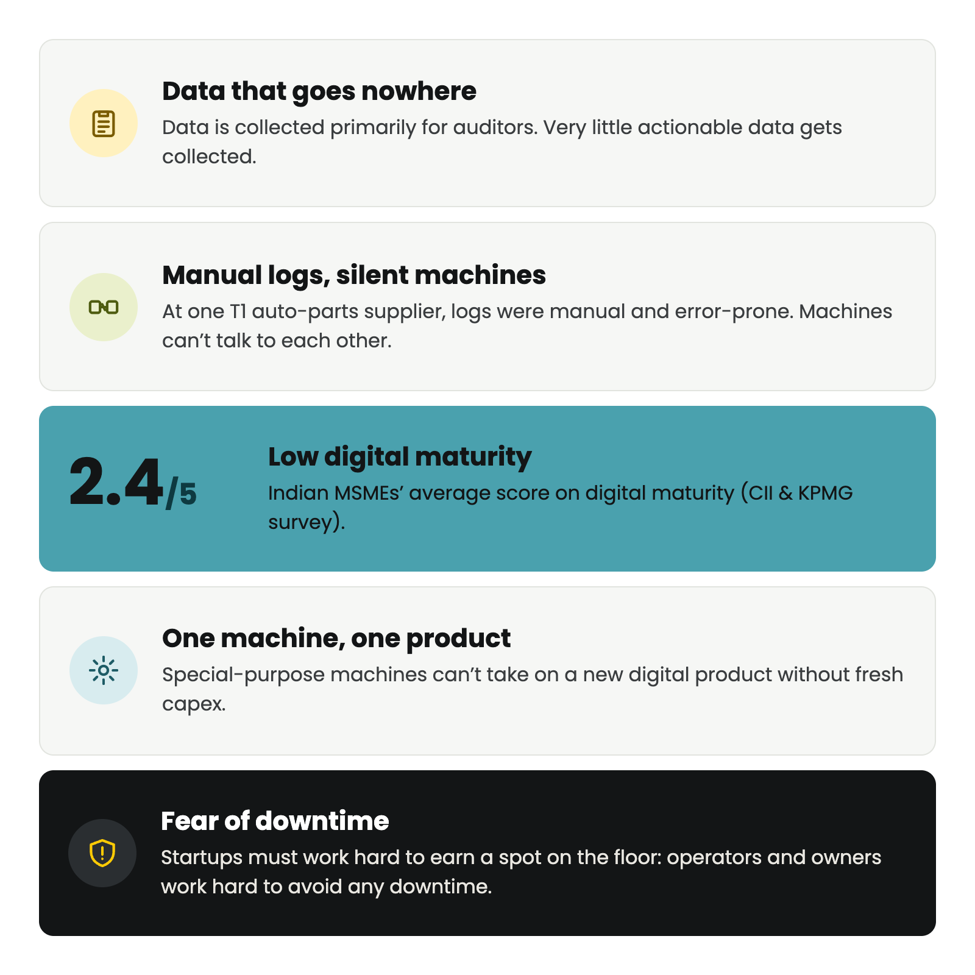
In our experience speaking with companies in the space, we have found that startups begin operations with an advantage in a particular segment: this can be access to a particular type of factory, the integration of a new data source into their intelligence layer, or a new type of sensor that can withstand extreme conditions. This alone, we have found, has not led to rapid scaling of deployments. We believe the key to scalability is not technology-led, because that generally evens out over time. It is rather the ability to rapidly acquire customers (via an opening technology or market access wedge) to get onto a virtuous feedback loop of product development by building a high quality corpus of data across machines and industries.
Like we said in the previous section, an Industry OS player must first earn the trust of a mid-market manufacturer and then deliver the subsequent intelligence layer on top. In a sense, these companies’ base operations will match with what system integrators do today: installing the sensor + intelligence system, running it and answering for it when something breaks. The company starts off with services: that work scales by building reusable pieces with every deployment. These pieces are connectors for common PLCs and machine makes, templates for each machine type, and most importantly, models pre-trained on similar machines elsewhere.
From an Industry OS players’ perspective, it is important to build the early foundation to then allow for rapid cross-plant and cross-industry scaling. We have seen well-funded industrial IoT startups in India spend years perfecting sensors and models, only to stall at a handful of large customers because their deployments did not get subsequently simpler over time.
Another pain point that an Industry OS solves is cross-plant data and learning from failures. In many manufacturing setups, failure data is rarely logged or labelled, and of course plants today do not learn from each other. This shortage of fault data is an obstacle for machine-learning maintenance models [13]. An Industry OS platform logs each failure against the machine, the sensor readings before it and the fix whenever applied, and pools these events across many plants and machine makes. Winning players will use federated learning techniques to protect client data while improving their own models. Augury, a US machine-health company, says its models are trained on more than 500 million hours of data from machines in production [14].
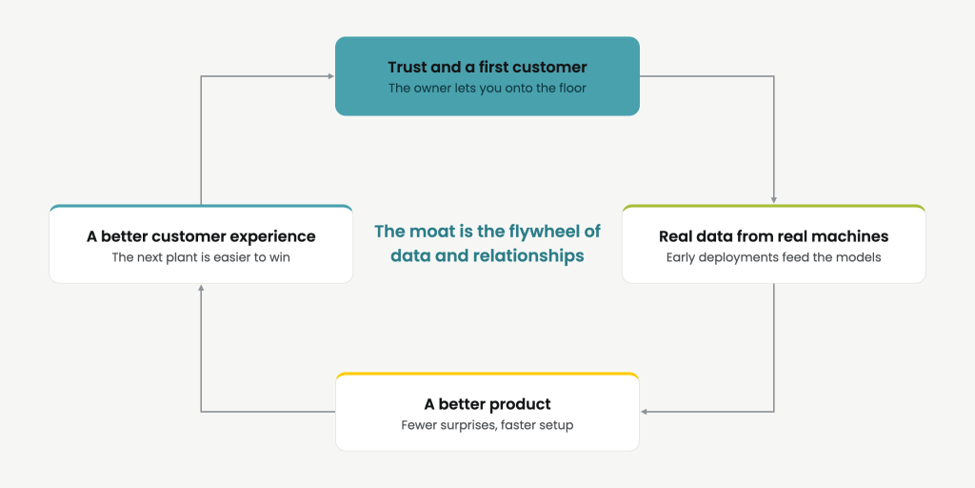
Caption: Every deployment starts with an owner who trusts the startup enough to let it onto the floor. Data from real machines improves the product, and a better product makes the next plant easier to win. Over time, this loop of data and relationships becomes the moat.
Industry OS players we are looking to invest in start off with a concrete wedge, either technological or market access. The services business serves as the entry point, and the overall Industry OS grows with each deployment. We believe that mature sensor platforms and current AI capabilities will unlock rapid scaling of a business that starts off as service-based. Traditional services businesses had headcount-based constraints on how rapidly they could scale - we believe that changes with AI-based approaches, particularly in this space. Thus, we believe that an Industry OS player who starts off as a systems integrator plus can be a venture-backable opportunity, as they set themselves up for rapid scaling across geographies and industries.
Additionally, as these companies increase their capability, we believe that they will unlock outcome-based pricing, e.g., earning a part of the extra output value they generate. This too allows them to scale their revenue beyond software & AI services, and participate in the upside that they generate for their customers.
To summarize, we are looking for founders who build data-driven platforms whose custom work shrinks with every plant they add and which integrate cross-learnings across machine types, different industries and different geographies. These companies earn their right to win by connecting to and driving concrete business outcomes for their customers. These companies will look partly like services businesses, since they install the system, run it and take accountability for it on site, with the intelligence and autonomy layer being built on top of that core business.
If you are building this, write to us at info@ankurcapital.com.
* Ankur Capital estimate, based on internal analysis.
⁺ Revenue range selected for this article.
‡ Global survey, not specific to India. Rockwell's 2026 survey covers 1,560 manufacturers with revenue above $100 million across 17 countries. IBM's study was published in May 2022.
[1] Ankur Capital, India's Intelligence Layer: Manufacturing Report 2026. https://www.ankurcapital.com/post/manufacturing-report-2026
[2] Siemens, The True Cost of Downtime 2024, June 2024. https://assets.new.siemens.com/siemens/assets/api/uuid:1b43afb5-2d07-47f7-9eb7-893fe7d0bc59/TCOD-2024_original.pdf
[3] IndustryWeek, Five Steps to Get Out of Pilot Purgatory (McKinsey Digital Manufacturing Global Expert Survey 2018), August 2018. https://www.industryweek.com/technology-and-iiot/five-steps-get-out-pilot-purgatory
[4] International Federation of Robotics, World Robotics 2026 press conference presentation, 24 September 2026. https://ifr.org/
[5] Ministry of Statistics and Programme Implementation, Release of the Annual Survey of Industries (2024-25) results, PIB, 30 September 2026. https://www.pib.gov.in/PressReleasePage.aspx?PRID=2316981
[6] Reserve Bank of India, Governor's Statement, June 2026. https://rbi.org.in/scripts/BS_ViewBulletin.aspx?Id=24238 and Order Books, Inventories and Capacity Utilisation Survey, Q1 2026-27, October 2026. https://www.rbi.org.in/Scripts/PublicationsView.aspx?id=24087
[7] Rockwell Automation, 2026 State of Smart Manufacturing Report (11th annual), May 2026. https://rockwellautomation.com/en-us/company/news/press-releases/90-of-Manufacturers-Say-Digital-Transformation-Is-Now-Essential-According-to-New-Global-Study.html
[8] IBM Institute for Business Value, Manufacturing 4.0: From data to decisions, May 2022. https://www.ibm.com/thought-leadership/institute-business-value/report/manufacturing-4-0
[9] CII and KPMG, Industry 4.0 Adoption and Strategic Roadmap for Indian Manufacturing, December 2024. https://smartmfgindia.com/Document/KnowledgeRepository/Industry%204.0%20Adoption%20and%20Strategic%20Roadmap%20for%20Indian%20Manufacturing-1-36.pdf
[10] National Productivity Council, EoI for empanelment of startups under RAMP Gujarat, December 2025. https://www.dpiit.gov.in/static/uploads/2025/12/cbdefb1863cc38fdba7831d65d35a271.pdf
[11] MIVA Robotics, Physical AI: When Intelligence Moves from Code to the Real World, February 2026. https://mivarobotics.ai/physical-ai-when-intelligence-moves-from-code-to-the-real-world/
[12] YourStory, SwitchOn raises $8M in pre-Series B funding round led by IvyCap Ventures, July 2026. https://yourstory.com/2026/07/manufacturing-tech-startup-switchon-pre-series-b-funding-ivycap-ventures
[13] Azari, Flammini, Santini and Caporuscio, A Systematic Literature Review on Transfer Learning for Predictive Maintenance in Industry 4.0, IEEE Access, 2023. https://doaj.org/article/fc819261a8ed4c1bb3b24d0e730d829f
[14] Design News, AI Tools for Engineers: Augury's Machine Health Solutions. https://www.designnews.com/artificial-intelligence/ai-tools-for-engineers-augury-s-machine-health-solutions

Registered Corporate Office
Ankur Fincon Management Pvt Ltd
Unit 5 Jetha Compound,
Byculla (E), Mumbai 400027
Bangalore Office
Ankur Capital,
BHive Platinum, 271, 6th Main Rd,
HAL 2nd Stage, Motappapalya,
Indiranagar, Bengaluru,
Karnataka 560008.
Delhi Office
Avanta Business Centre Central Delhi
3rd floor, Ambadeep Building,
14, KG Marg, Barakhamba,
New Delhi, Delhi 110001