TL;DR
Meeting the world's, and India's, demand for carbon-free, low-footprint and stable baseload power is arguably the biggest infrastructure challenge ahead of us for the next two decades. Nuclear fusion fundamentally solves this. We called out that the next frontier for us was new energy generation in our recent 2025 India Deep Science Tech Report. Three months later, here we are.
There’s a running joke in physics circles that commercial fusion is always 30 years away, and has been for 30 years. Why is today any different?
To understand this, we need to know what it takes to produce energy via fusion, and in fact, how to get nuclear fusion reactions to happen in the first place. At its core, fusion is the process of replicating the nuclear reactions of the Sun and generating energy by fusing hydrogen atoms into helium. Fusion is "solved" when:
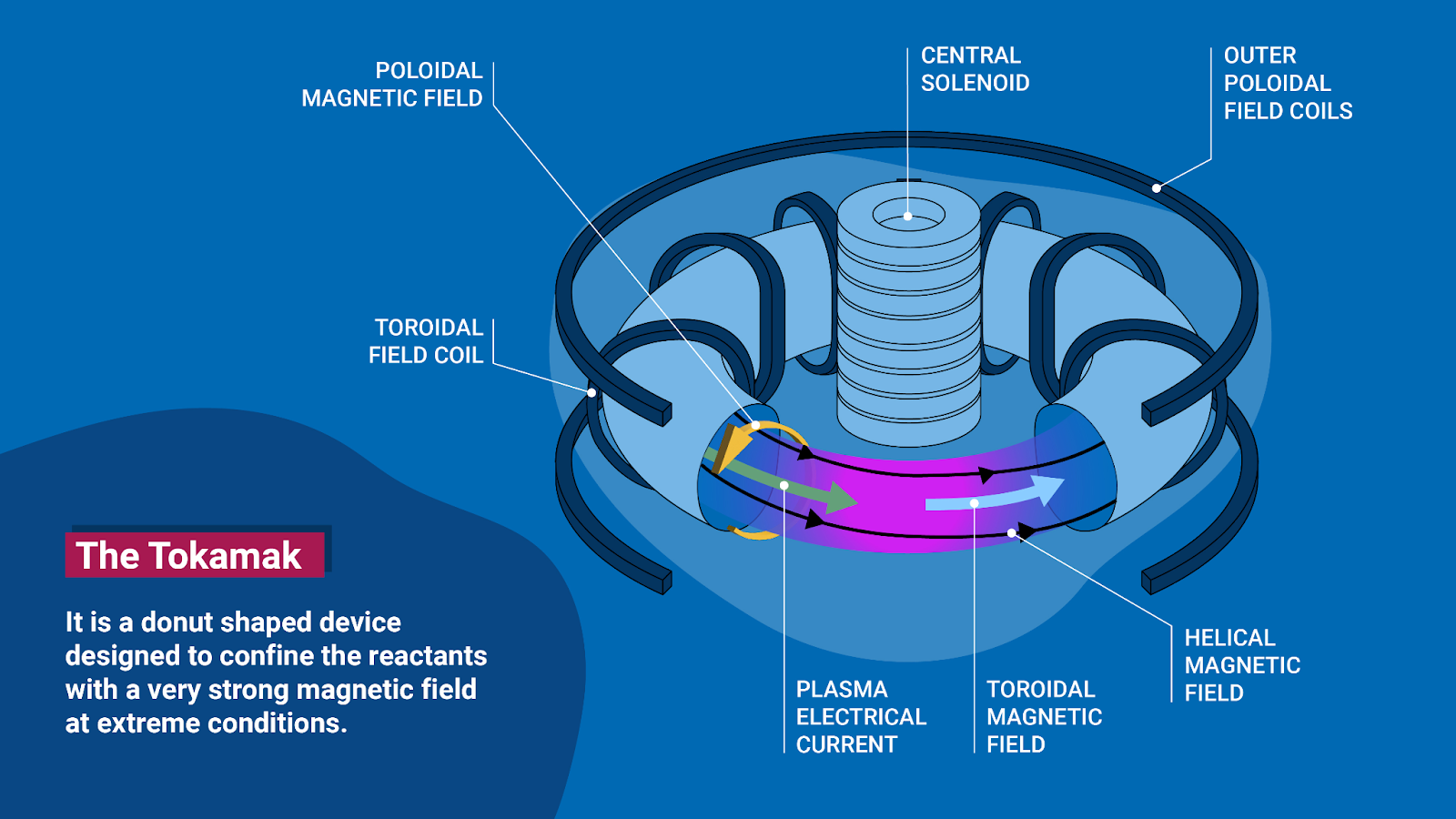
The two main approaches to plasma confinement are magnetic confinement, where a system of powerful magnets encircling the reactor maintains the plasma and inertial confinement, where strong lasers apply radiation pressure on the fuel to achieve the same effect. Across both approaches, fusion has been bottlenecked for decades by the inability to satisfy all three criteria simultaneously.
Further, fusion reactors developed thus far have been massive - both in terms of size and capital requirements. ITER, the international magnetic confinement experiment being built in France, has cost over $25 billion. Commonwealth Fusion Systems (CFS), one of the most well-regarded private fusion companies, has raised over $1.8 billion to build its SPARC prototype, a compact machine at roughly 1/40th the size of ITER.
Two technological advances, arriving together, have fundamentally changed the picture.
The first is high-temperature superconducting (HTS) materials. Over the last 20 years, peak magnetic fields have more than doubled, and operating temperatures have jumped from a chilly 4 Kelvin to far more manageable 20 Kelvin. A magnet that could lift a car earlier can now lift a fully loaded truck. When these magnets are used in fusion reactors, they have a nonlinear effect on the plasma confinement. The Lawson triple product (a key figure of merit for fusion) scales as the cube of the magnetic field B and the output energy density scales even better, as the fourth power of the magnetic field. Stronger magnetic fields mean tighter plasma confinement, which means you can achieve the same fusion conditions in a dramatically smaller machine.
The second piece of the puzzle is computational control. Fusion reactors maintain their plasma temperature at tens of millions of degrees, and this plasma is prone to instability. Faster algorithms, computational resources and newer actuators have allowed for two things: (a) much better control algorithms that can maintain plasma stability for longer, and (b) low-latency, microsecond level adjustments for plasma control.
We are at a critical shift now - the National Ignition Facility demonstrated a Q factor greater than 1 for the first time ever in 2022, meaning that the fusion reactor generated more energy output than input. This result has been reproduced multiple times since 2022. Fusion is no longer a question of if. It is a question of when, and at what cost.
The remaining challenge is reactor size, cost, and development timelines, and this is precisely where Pranos has staked out its position. They are building three things in lockstep: JENGA, their plasma control software; PRAGYA, their compact tokamak; and MAGGA, their HTS magnet program. Their low-aspect-ratio tokamak design, combined with 20+ Tesla HTS magnets, gives them a credible pathway to a reactor that is significantly more compact and lower cost than what peers like Commonwealth Fusion Systems (CFS) are pursuing. CFS has raised over $1.8 billion for its SPARC prototype, itself a machine at roughly 1/40th the size of ITER.
Pranos aims to build its net energy gain reactors at a fraction of this cost. Crucially, by developing hardware and software together in tight feedback loops, Pranos will compress the development timeline and establish an accelerated path to their net energy gain reactor, PRANIQ.
Pranos was founded in 2024 by Shaurya Kaushal and Roshan George. From our first meetings with them, we knew they had what it takes to build a nuclear fusion startup. They bring complementary experience in the two key pillars of Pranos' technological efforts.

Shaurya comes with a PhD in computational fluid dynamics and leads the overall physics and hardware engineering aspects of the company. Roshan has a background in computer science and has spent a significant amount of time building digital and intelligence platforms for the energy industry before turning that experience toward fusion's hardest software problems. At Pranos, he leads the software and control algorithms effort. Together, they lead a multidisciplinary team spanning HTS magnets, plasma physics, and software engineering.
What also gave us confidence is something most people outside the fusion world don't know about India. India's participation in the global ITER collaboration isn't limited to academia: Indian companies provide vital components like cryostats, cryolines and shielding technology. All in all, over 200 companies are involved in directly and indirectly supplying components to ITER. This industrial base, built up over decades of precision engineering for fusion-grade requirements, is almost like an extended team for Pranos. The vacuum vessel for PRAGYA, for instance, is being manufactured by Ranvac, a company with prior fusion vessel experience.
On the policy side, the tailwinds are building. Pranos is incubated at the Jawaharlal Nehru Centre for Advanced Scientific Research (JNCASR) and the Institute for Plasma Research (IPR) and has close collaborations with ITER, and has established key collaborations with the Department of Science & Technology as well as the Department of Atomic Energy. The policy environment is building meaningfully in parallel: the recent passing of the SHANTI bill allows for private and foreign direct investment into nuclear efforts, and the Anusandhan National Research Foundation (ANRF) has established dedicated capital pools for deep science collaboration.
Since our first conversation with the team, we've been continually impressed by the clarity of the path ahead and the sequence of steps to hit the right milestones. The immediate next step is to achieve first plasma in their prototype reactor, PRAGYA, and then to collect operating data from it to fine-tune their JENGA software stack. In parallel, Pranos will start building and testing their HTS magnets, which will be tested with PRAGYA and incorporated into PRANIQ.
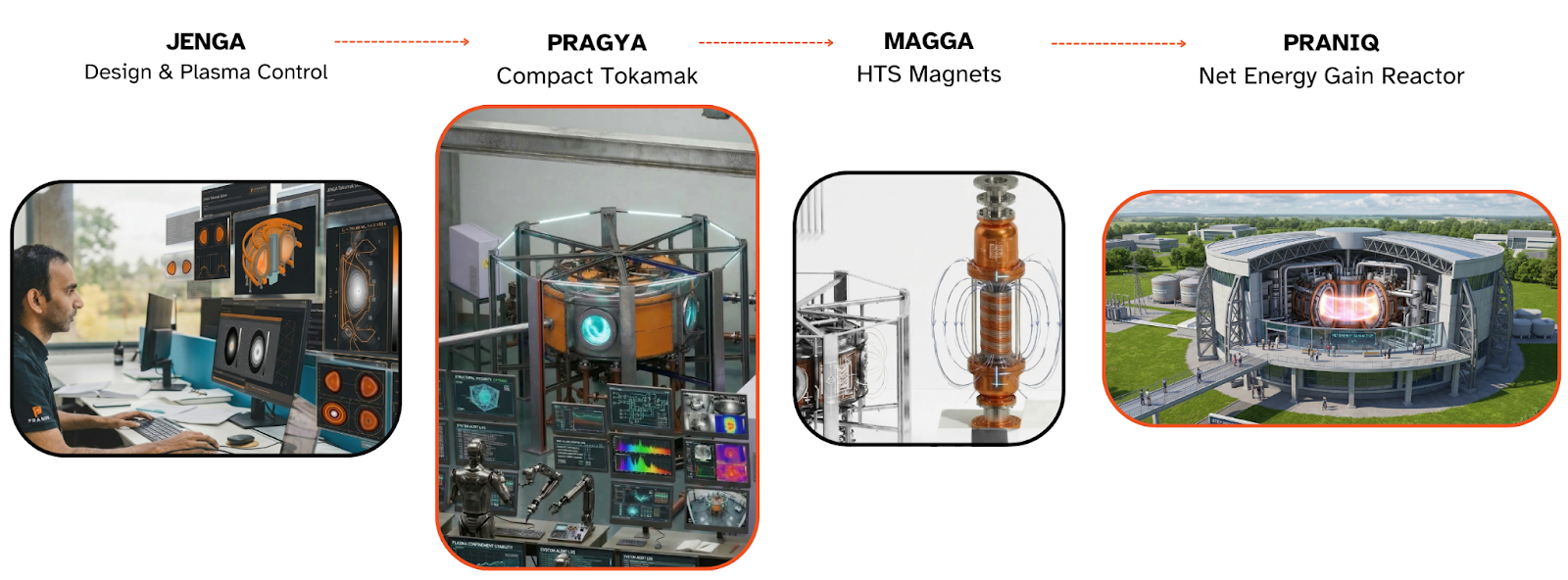
Over the next two years, these activities will converge. Armed with operational tokamak data, ready-to-deploy HTS magnets and a mature JENGA stack, Pranos will be ideally placed to build out their net-energy gain reactor.
As Shaurya puts it: "We stand on the shoulders of brilliant fusion physics. Now, the world needs the commercial infrastructure to bring it to the grid — the technology to design, construct, and operate fusion power plants at scale. At Pranos, we are building exactly that, and we are beginning our contribution today, from India."
We are proud to back them as they embark on one of the most consequential journeys in the Indian deep science tech ecosystem today.

Registered Corporate Office
Ankur Fincon Management Pvt Ltd
Unit 5 Jetha Compound,
Byculla (E), Mumbai 400027
Bangalore Office
Ankur Capital,
BHive Platinum, 271, 6th Main Rd,
HAL 2nd Stage, Motappapalya,
Indiranagar, Bengaluru,
Karnataka 560008.
Delhi Office
Avanta Business Centre Central Delhi
3rd floor, Ambadeep Building,
14, KG Marg, Barakhamba,
New Delhi, Delhi 110001