At Ankur Capital, we launched Ankur Dialogues as an invite-only series that brings together founders, researchers, policymakers and investors for candid conversations on the technologies shaping the next decade. Rather than looking at headlines, these discussions explore the deeper technological, commercial and policy shifts that create entirely new markets.
Our first edition featured Rya Jetha, Bay Area-based technology reporter, who shared an insider's perspective on the rapid evolution of autonomous vehicles, robotics and Physical AI. Covering some of the world's most influential technology companies, Rya offered a ground-level view of where the ecosystem is headed and where it still faces significant challenges.

Here are some of the biggest themes that emerged from the discussion.
The conversation moved beyond generative AI to what many believe is its physical manifestation: machines capable of perceiving, reasoning and interacting with the real world.
Across Silicon Valley, capital is increasingly flowing toward robotics startups that combine advances in large language models with sophisticated hardware systems. Yet unlike software, robotics requires expertise across sensing, control systems, manufacturing and deployment - making it a fundamentally multidisciplinary challenge.
Many founders today are not first-time entrepreneurs, but engineers who previously built products at companies like Tesla, Figure AI and other frontier AI labs. Experience has become a significant competitive advantage.
Autonomous vehicles provided one of the clearest examples of how breakthrough technologies reach mainstream acceptance.
While public skepticism around self-driving cars was initially high, user sentiment shifted rapidly once people experienced the technology firsthand. In the Bay Area, autonomous vehicles have become part of everyday life for many residents, demonstrating that product experience can often overcome initial hesitation.
The bigger challenge today is no longer purely technical - it is regulatory.
Each city presents different policy environments, requiring companies to navigate local governments, regulators and public opinion alongside engineering execution. For frontier technologies, government engagement is becoming as important as technological innovation.
One of the strongest themes from the discussion was that robotics is no longer simply about building better robots.
The ecosystem now spans:
Building intelligent machines requires advances across the entire stack, creating opportunities far beyond the robot itself.
For founders, this means some of the most valuable companies may emerge by solving enabling infrastructure problems rather than building the final robot.
Large language models were trained on vast amounts of internet text.
Robots, however, need something entirely different.
They must learn from physical interactions - folding clothes, handling objects, assembling components, navigating factories and performing countless real-world tasks. Creating this structured data is expensive, manual and highly specialised.
In many cases, companies are recording thousands of hours of humans performing specific activities simply to generate training datasets.
As robotics scales, data infrastructure could become one of the industry's most valuable layers.
For India, the discussion highlighted opportunities that extend well beyond building robots.
The country has strengths in engineering talent, manufacturing, AI research and large-scale operations that could enable startups across the Physical AI value chain - from data infrastructure and industrial automation to specialised sensors, simulation software and robotics-enabled manufacturing.
Rather than replicating Silicon Valley, India has the opportunity to build differentiated advantages in the technologies that underpin intelligent machines.
An interesting observation from the discussion was how investor interest is evolving.
As AI models become increasingly commoditised, many investors are expanding their focus toward robotics and Physical AI. The belief is straightforward: in a world where intelligence becomes abundant, the ability to interact with the physical world becomes increasingly valuable.
This shift is driving investment not only into robotics companies themselves, but also into the enabling technologies surrounding them.
The future of Physical AI will not be determined by algorithms alone.
Progress will depend equally on advances in sensing, data, hardware, manufacturing, regulation and deployment. The winners are likely to be those who can integrate these disciplines into scalable businesses rather than optimise a single component.
At Ankur Capital, we believe these intersections are where the next generation of deep science companies will emerge.
Conversations like this are exactly why we started Ankur Dialogues - to bring together diverse perspectives from around the world and explore the technologies that will define the coming decade.
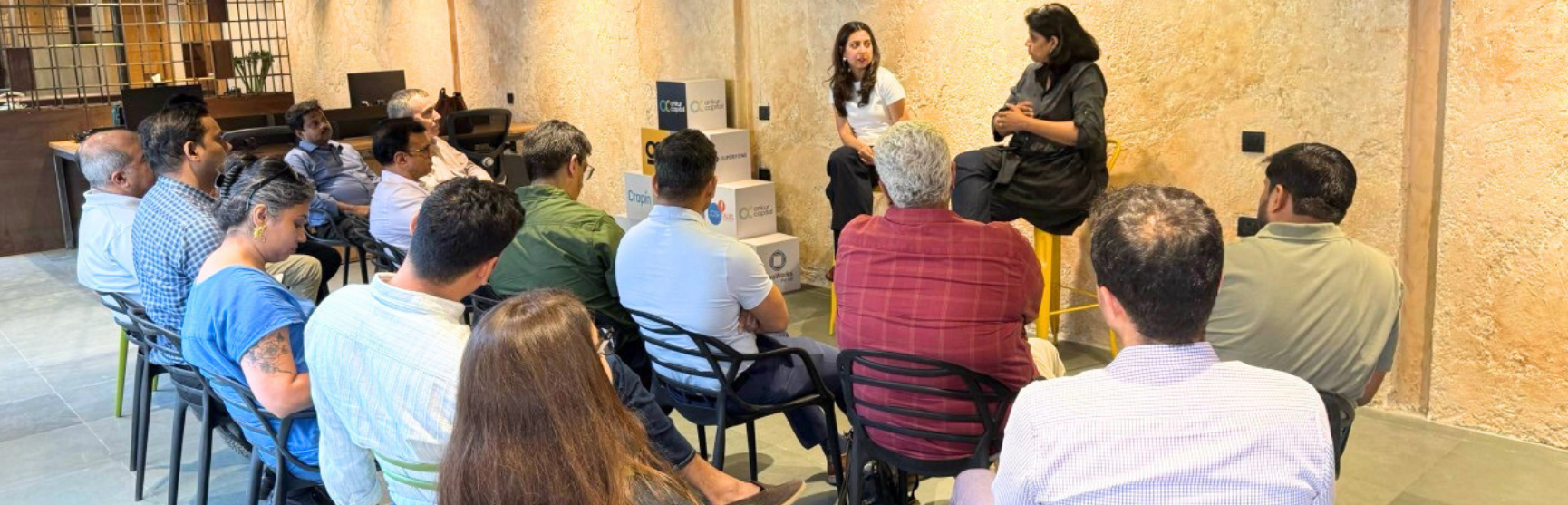
We look forward to many more discussions at the frontier of deep science and innovation.

Registered Corporate Office
Ankur Fincon Management Pvt Ltd
Unit 5 Jetha Compound,
Byculla (E), Mumbai 400027
Bangalore Office
Ankur Capital,
BHive Platinum, 271, 6th Main Rd,
HAL 2nd Stage, Motappapalya,
Indiranagar, Bengaluru,
Karnataka 560008.
Delhi Office
Avanta Business Centre Central Delhi
3rd floor, Ambadeep Building,
14, KG Marg, Barakhamba,
New Delhi, Delhi 110001